Political Education in Greater Baltimore DSA
Learn to understand the world in order to effectively change it!
Learn to understand the world in order to effectively change it!
/j6iizexe0v3e3yt1laldaxyn55qh)
Join us at our upcoming events!
What is it?
Human societies have long been shaped by struggle between those who perform the labor that sustains society and those who own and control its products.
In capitalism, this struggle between classes takes the form of a division between workers and capitalist owners. If you have to work to live, you're part of the working class. If you live primarily off profit generated by others' labor, you're part of the capitalist class.
Workers don't own the tools, factories, or resources needed to produce goods (aka the means of production) so they have no choice but to sell their labor to those who do. But the working class is never paid the full value of what they produce.
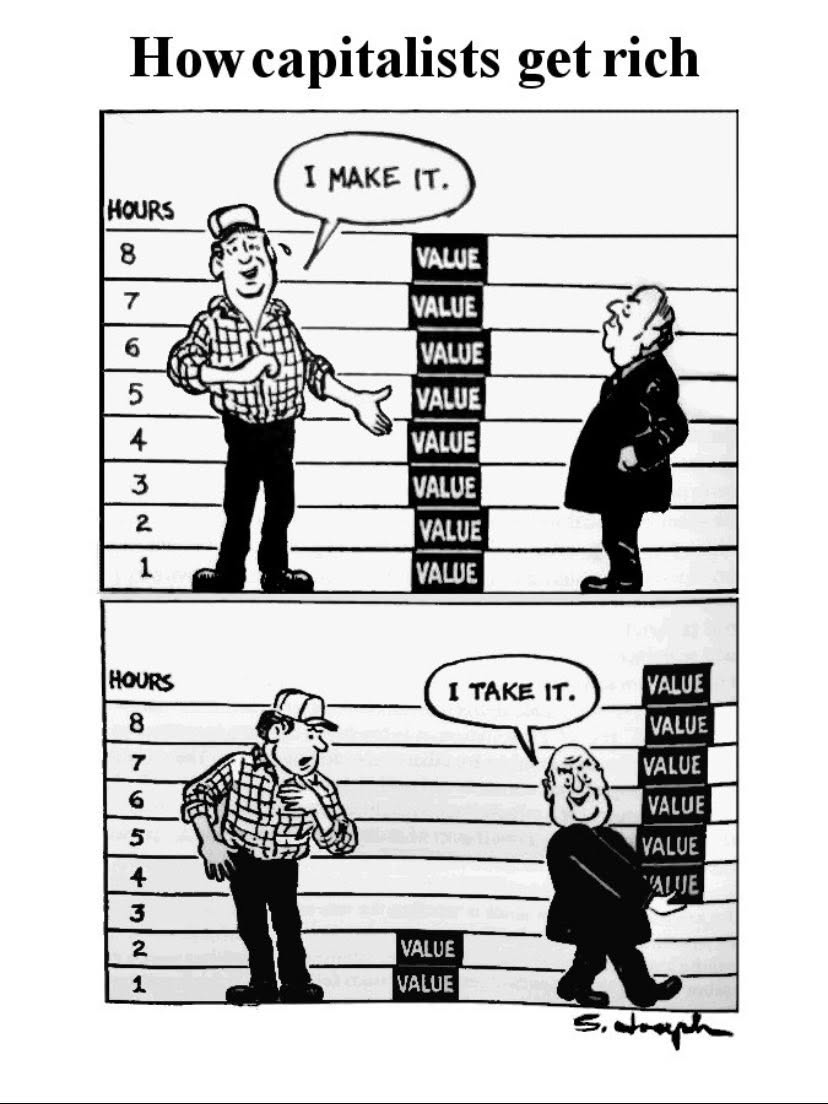
The wealth of the capitalist class comes directly from the exploitation of the working class, by pocketing most of the value created by our labor as profit. Because profit originates in what is taken from workers, the interests of the working class and the capitalist class are structurally and fundamentally opposed by the basic logic of capitalism.
This struggle between the classes plays out constantly in workplaces, in politics, and in everyday life, and it's why capitalism cannot simply be reformed to serve the majority. However, the same conditions that produce this class conflict also create its solution: a working class with both the motive and the collective power to build an alternative.
Learn More
VIDEO: Richard Wolff on Capitalism
Primer on Class, Midwest Socialist
The Theory of Value and Surplus Value, Ernest Mandel, An Introduction to Marxist Economic Theory
"What is Capitalism?", Michael Heinrich
Historical Materialism, Frederich Engels, Socialism: Utopian and Scientific
Capital and Capitalism, Ernest Mandel, An Introduction to Marxist Economic Theory
Chapter 8, Karl Marx, Wage Labor and Capital
Chapter 9, Karl Marx,Wage Labor and Capital
But at Least Capitalism Is Free and Democratic, Right?, Erik Olin Wright, Jacobin: A short response to capitalist writer Milton Friedman, in which Wright argues that capitalism is in direct conflict with the exercise of human freedom.
How to Be an Anti-Capitalist for the 21st Century, chapters 1 and 2, Erik Olin Wright: These chapters provide an introductory examination and critique of the capitalist system. Wright argues that capitalism, by its very nature, is incompatible with the ethical values of equality, freedom, and community.
Where Despots Rule, Elizabeth Anderson, Jacobin: An interview with political philosopher Elizabeth Anderson about her book Private Government. In that book, Anderson argues that the workplace constitutes a "private government" in which workers are subject to the dictatorial will of their bosses.
Understanding Capital: Marx's Economic Theory, chapters 2–4, Duncan K. Foley: A summary of some of the basics of Marx's critique of capitalism.
What is it?
Socialism is the alternative to the capitalist system.

Socialism is characterized by the social ownership of the means of production, where the economy is run for human wellbeing and to meet human needs rather than generate profit.
The goal is to end class exploitation and abolish class divisions and abolish this long ongoing process of the many working all their lives for the wealth of a few.
Workers are the majority, the ones who produce the wealth of society, and therefore we are also the force capable of transforming it.
The rule of the capitalist class over the political and economic sphere has to be replaced with the rule of the majority, the rule of the working class.
Through organization and class solidarity, people can build the power needed to replace the rule of a small owning class with the rule of the majority, free all peoples oppressed and exploited by capitalism and create a more equitable future endeavoring toward the advancement of humanity.
Learn More
Why Socialism?, Albert Einstein
Proletarians and Communists, Karl Marx and Fredrich Engels: The Communist Manifesto
Why We Need Socialism in America, Michael Harrington, Dissent
Social Democracy is Good. But Not Good Enough, Joseph M. Schwartz and Bhaskar Sunkara, Jacobin: Socialists want maximal democracy and freedom, and for that reason are not content with a kinder, gentler capitalism. But, as Schwartz and Sunkara argue, even if we were happy with a reformed capitalism, reforms which significantly set back capitalist interests are impossible to maintain.
What Should Socialists Do?, Joseph Schwartz and Bhaskar Sunkara, Jacobin
The Problem of Reformism, Robert Brenner, Against the Current
Beyond Social Democracy, Ralph Miliband and Marcel Liebman, Socialist Register
Building a Mass Socialist Party, Sam Gindin, Jacobin
/m2q5fkcr5js96av23lzmeb3wul8c)